
Back to the EBT Locomotive Roster
This page last revised 8/13/2026
This page last generated 8/28/2026 2:27:10 PM


| Number: M-3 | Name: none | |
|---|---|---|
| Date Built: 1928 | Date Purchased: 1924 | Date Sold: none |
| Line Built for: East Broad Top | Disposition: Serviceable | |
| Builder: Nash/EBT | Model: custom | Serial Number: 45552 |
| Style: gas-mechanical | Type: Inspection | Wheel Arrangement: 1A |
| Track Gauge: 3' | Tractive Effort: | Pressure/Power: |
| Valve Gear/Transmission: Transmission | Driver Size: | Cylinder Bore: |
| Weight: | Engine Weight: | Adhesive Weight: |
| Grate: n/a | Fuel Capy.: | Water Capy.: n/a |
| Published Photos: AEBT 55, 165; EBT 138, 219; SGS 98, TMB 49 | ||
M-3 is the last of the Common Carrier Era "M units". Unlike M-1 and M-2, M-3 was never intended to haul passengers and was generally used as an inspection car by middle management. It also served in a maintenance of way role.
As originally built in 1924, M-3 did not have a number and lacked many of the features it would have later. This first version was based on the drive train of a Maxwell automobile (Maxwell later became Chrysler.) The car only had a band brake on the ouput shaft of the transmission and none on the wheels. It featured a pilot (cow catcher) on the front in its early years, but it was later removed (A replica pilot was constructed and installed for the restoration of the car.) For most of its common carrier life, M-3 had a Model T winsdshield which featured split glass in a frame that could be folded down to allow ventilation. It was still in place in 1950 but by 1952 the windshield had been replaced by a single sheet of glass which was in place until the restoration. AA295 AA292
In 1928 the car received many modifications and was rechristened as M-3, the next car in the numbering series started after the car was initially constructed. Most notably the Maxwell engine and transmission were replaced by Nash engine and transmission. The Nash radiator and cowling also replaced those from the Maxwell, but the rear cowling support of the Maxwell remained against the firewall, causing the Nash cowling to never set properly and scrape the body when opened. The car recived two brake pads on each front wheel and one each on the rear, mechanically connected to a brake lever inside the car to compliment the band brake. The rear axle was from a Ford Model A, and was likely installed at the 1928 rebuild. The tail lights on either side of the rear were from a Ford Model T.
From the car's original construction in 1924, it had a klaxon horn ("aooga" horn) located above the windshield. A curved bell horn was added later to the left fender. It was not present in 1947, 1949 or 1950 photos, but was in 1952 photos. The horn was still in place in 1956 and at the reopening in August 1960. It was not present in 1970s photos of the car stored in the Locomotive Shop. As such it is unclear exactly when the fender horn came and departed.
The Nash engine is an inline 4 cylinder, probably a "40 Series" which was produced from 1921-24. It had a 165.92 cubic inch (2719 cc) displacement (increased to 201.32ci / 3299 cc in early 1921,) with 3.25" bore and 5" stroke. It developed 35 HP, and 36.75 HP in its later version. EBT documentation, however, list the engine as 177.92 ci (2916 cc) with a 3.375 bore and 5" stroke, and devloping 18.25 HP. AA1428 Unusually for its time, it featured overhead valves. However, the overhead valve train has to be manually lubricated on a regular basis as it has no built in pressurized oil passages. The engine was clearly used when it was installed in M-3, as the head had a hole in it, likely from a dropped valve being forced through the head by a piston. The hole was patched using a copper rod and the patch has held compression for nearly a century now. The Nash transmission is non-synchronized and requries double clutching when changing gears. Double clutching involves separately engaging the clutch for going out of a gear and going into a gear. It incudes changes in throttle to get the engine to the right speed before engaging the new gear. The first introduction of synchronized gears was in 1927.
It appears that the maintenance of the M-3 engine fell to the East Broad Top Transit Company during its existance. As of 1936, the inventory lists a spare identical Nash engine for the M-3 in inventory as a spareAA1428
The car sometimes towed a trailer with a small turntable on it, essentially two rails tapered at one end and laterally connected together. The turnable was set by hand on a large iron casting that was set on a railroad tie. The car could be run up on the table and turned around by hand then driven back off. The turntable and casting were in storage in the Lumber Shed until about 2009, after which the casting disappeared. The current location of the turntable is unknown.
For most of the car's common carrier time it lived in a leanto shed attached to the Electrical Shop. The track into the leanto is likely the tightest cuve on all the East Broad Top Railroad.
M-3 was brought out for display a number of times in the early 1960s but there are no photos or videos of the car running. The most common photos appear to date from the August 13, 1960 reopening of the railroad, where M-3 and several speeder cars and trailers were displayed together near the Electrical Shop.
During this time, the car had a green hood and red radiator. These were not Common Carrier era colors as both were black. Both were changed to black during the later restoration.
In the 1970s M-3 was stored in the Locomotive Shop. At some point in the Kovalchick Tourist Era, the car was moved into the Paint Shop on wood rails that had been placed on the shop floor beyond where the steel rail ended. It remained there through the 1990s and early 2000s.
M-3 appears to have never been brought out for display after the 1960s. Over the years, the story circulating about M-3 was that the engine was run in the 1960s without enough oil and had seized. This story was generally accepted as fact, but during the restoration it turned out to be false.
When Friends of the East Broad Top leased the Paint Shop as a restoration shop in 2004, the equipment stored there, including the M-3 and Aughwick Coach, had to move elsewhere. This appears to have prompted the first attempt to restore M-3. The car was transported from the railroad to the shop of an EBT employee where he and a Rockhill Trolley Museum volunteer attempted to get the car operational. These attempts were unsuccessful.
The car was subsequently moved to the shop of Rockhill Trolley Museum volunteer Larry Freeman in Honey Brook, PA. The engine was removed from the car and sent to the shop of another RTM volunteer Herb Kephart for rebuilding.
The car body was completely stripped down to the metal frame for a complete restoration. All metal parts were stripped and repainted. As part of the restoration wood parts and canvas sides and roof were replaced. Some modifications were made to the car for safety and longevity. The fuel tank was historically filled from inside the car by flipping up one of the seats and accessing a port directly on the tank. This was changed to a hidden external fuel filler connected to the tank by a tube. During the restoration a removable bar stool style seat was added in the center near the console to allow easier operation than from a side bench seat. The stool is removable to return the car to its previous appearance. The original riveted fuel tank was replaced by a modern welded tank.
The engine was heavily worn and so was also completely stripped down and rebuilt. The wear is likely due to the fact the car runs much more slowly in reverse than forward and was probably over-revved to get more speed when backing up. Parts were difficult to obtain due to the age of the drive train and some parts had to be adapted to fit. Valves from a Subaru engine turned out to be a perfect match to the originals. The side tubes on the Model A rear end were cut out and replaced with Ford F250 tubes and bearings, making future bearing replacement much easier.
A replacement fender horn that resembled the original was installed, but on the opposite fender due to the location of the trigger mechanism on the replacement. The replacement fender horn is a No. 90 "Fog Horn" manufactured by the Jubilee Manufacturing Company of 1931 South 20th Street, Omaha, NE. The horn likely dates from the 1950s. It is 6V and mechanically rather than electrically activated. It is in series with a 6V light bulb to lower the 12V of the car to 6V for the horn. The replacement horn was mounted on the right rather than left fender, to better accommodate the mechanical activation arm. The solid pane windshield was replaced with a period-correct Model T split windshield like the original. A retractable hitch was added to the rear to allow towing, but not impede riders entering the car.
These notes only scratch the surface of the efforts required to restore M-3 to service. More details will be added here at a future time.
The M-3 does not operate a regular schedule, but is operated a few times a year for special events. On rare occasions it operates on the mainline, but more commonly just in the yard. The car holds about five passengers in addition to the operator.
| Visit this search term record listing at the EBT Archvies and Special Collections |
|---|
| Reference Photos at the Archives - Click on image to visit record |

Reference AP5206 (Ed. note: 1940) 
Reference AP5205 (Ed. note: 1947) 
Reference AP295 (Ed. note: 1950) 
Reference AP292 (Ed. note: 1952) 
Reference AP414 (Ed. note: 5-1960) 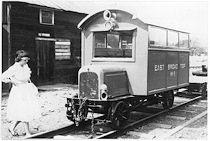
Reference AP6453 (Ed. note: summer 1960) 
Reference AP1070 (Ed. note: ca 1962) 
Reference AP2575 (Ed. note: ca 1970) |
| Reference Diagrams at the Archives - Click on image to visit record |

Reference AA142 |
Back to the EBT Locomotive Roster
